Wednesday, 6 May 2015
Friday, 1 May 2015
Bill Shankly
William "Bill" Shankly OBE (2 September 1913 – 29 September 1981) was a Scottish footballer and manager who is best known for his time as manager of Liverpool.
Shankly came from a small Scottish mining community as one of five brothers who played football professionally. He played as a ball winning right half and was capped twelve times for Scotland, including seven wartime internationals. He spent one season at Carlisle United before spending the rest of his career at Preston North End, with whom he won the FA Cup in 1938. His playing career was interrupted by his service in the Royal Air Force during the Second World War. He became a manager after he retired from playing in 1949, returning to Carlisle United. He later managed Grimsby Town, Workington[1][2] and Huddersfield Townbefore moving to become Liverpool manager in December 1959.
Shankly took charge of Liverpool when they were in the Second Division and rebuilt the team into a major force in English and European football. He led Liverpool to the Second Division Championship to gain promotion to the top-flight First Division in 1962, before going on to win three First Division Championships, two FA Cups, four Charity Shields and one UEFA Cup. Shankly announced his surprise retirement from football a few weeks after Liverpool won the 1974 FA Cup Final, having managed the club for fifteen years, and was succeeded by his long-time assistant Bob Paisley. He died seven years later at the age of 68
Thursday, 30 April 2015
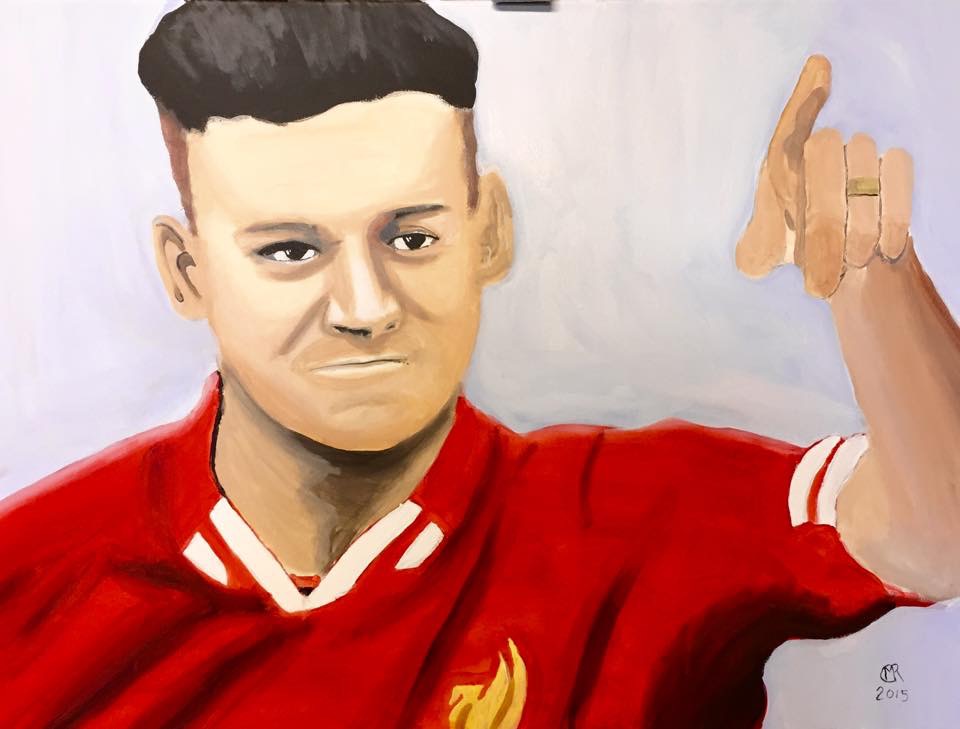
Philippe Coutinho
Philippe Coutinho joined Liverpool in January 2013 from Inter Milan.
His talent was evident from an early age, with comparisons being made in his homeland to several of Brazil's modern stars - including Kaka and Ronaldinho - due to the attacking midfielder's deft touch and creativity.
He began his career at one of Rio de Janeiro's biggest clubs, Vasco da Gama.
Alerted to his potential at 16 years old, Europe's heavyweight clubs battled for his signature and it was Italian giants Inter Milan who won the race to conclude a transfer worth around €4million in 2008.
Due to Italian rules, Coutinho was ineligible for his new club until his 18th birthday so remained at Vasco to continue his education. In 2009, he helped Brazil's U17 side claim South American spoils, scoring in the final against Argentina.
Coutinho appeared for Vasco on 43 occasions in total, netting five goals, before his transfer to Inter - then managed by former Reds boss Rafa Benitez - was completed in the summer of 2010.
"He is a young player with lots of quality. He can be the future of the club and we expect him to do very well for us," said Benitez when the Brazilian arrived at the San Siro.
Capable of playing in any forward position, Coutinho was regularly used in a wide role by I Nerazzurri - making his debut in the Uefa Super Cup and racking up 20 games and a single goal in 2010-11.
The Brazilian enjoyed further international success in 2011, featuring in all seven matches and finding the target three times as the U20 side lifted the U20 World Cup in Colombia.
Injuries would hamper the midfielder's progress into the Inter first team, with just eight appearances the following season before the Italians loaned Coutinho to Spanish outfit Espanyol for the second half of 2011-12.
There he thrived - under the stewardship of Mauricio Pochettino, the diminutive attacker played consistently and struck five goals before returning to Inter with a first-team spot in his sights.
During 2012-13, Coutinho was largely used in the Europa League by boss Andrea Stramaccioni, striking twice as the Italians qualified for the knockout stages.
Then after weeks of speculation regarding his future, the 21-year-old completed a move to Anfield in January 2013 as Brendan Rodgers further honed his Liverpool forward options.
Coutinho was handed a first appearance for the club as a substitute during the home defeat to West Brom on February 11, then found the target on his full Liverpool debut six days later with a calm finish against Swansea.
The diminutive playmaker's sublime passing range and vision ensured he became an instantaneous favourite among Kopites, who have regularly been stunned by the creativity of the No.10.
In 2013-14, the Brazilian evolved into an all-action midfielder, equally comfortable pressing hard to win possession, and his performances were a central tenet of the Reds' run to a second-place finish.
While Liverpool endured a testing start to the 2014-15 campaign, Coutinho's influence over the side grew, especially after Rodgers handed the playmaker a more free, attacking role in a revamped 3-4-3 formation.
Then, on February 3, 2015, Coutinho reaffirmed his commitment to the cause by signing a new long-term contract at the club.
Saturday, 25 April 2015
Gus Poyet
Painted in 2010
Gustavo Augusto "Gus" Poyet Domínguez (Spanish pronunciation: [ˈpoʝet]; born 15 November 1967) is a Uruguayan former footballer and manager.
Poyet played as a midfielder and began his career with short spells at Grenobleand River Plate. He then spent seven years at Real Zaragoza, with whom he won the Copa del Rey and the UEFA Cup Winners' Cup. In 1997, Poyet moved to Chelsea on a free transfer and helped the club win the FA Cup and the UEFA Cup Winners' Cup. In 2001 he moved to Tottenham Hotspur, where he saw out the remainder of his career. He was also part of the Uruguay side which won the 1995 Copa América.
After his playing career ended, Poyet moved into coaching. He served as assistant manager to Dennis Wise at Swindon Town and Leeds United, and Juande Ramos at Tottenham Hotspur. In November 2009, Poyet was appointed manager of Brighton & Hove Albion and in his first full season led the club to promotion as League One Champions, for which he was named League One Manager of the Year by the LMA. In October 2013 he was hired by Premier League team Sunderland and guided them to the League Cup Final in his first season, but was sacked in March 2015 after a poor run of results.
Thursday, 23 April 2015
Friday, 3 April 2015
Bosnia Summer Tour 1995
I, Matthew Rhodes, was the gunner for Major Barnes, OC for C Company, 1st Battalion the Devonshire and Dorset Regiment whilst in Bosnia.
Bosnia, 1995
The Warriors, resplendent in their white United Nations livery, sailed from Emden, via Southampton, to Split. The 1st Battalion flew to Bosnia in late April, assuming responsibility for its duties as 'BRITBAT 1' on 4 May 1995. A Company (Major Watson) was based at Gornjï Vakuf, B Company (Major McFarlane) and Battalion HQ were at Vitez while C Company (Major Barnes) was at Zepce/Jelah. Liaison responsibilities, so vital with the Battalion dispersed in this way, rested with HQ Fire Support Company. During the first three weeks there was an eerie calm. The companies mounted guards and manned checkpoints and they attempted to win 'hearts and minds' by, for example, playing football and providing medical assistance. At the end of May relations between the Bosnian Serbs and the UN deteriorated. The Serbs attacked UN Safe Areas, the UN responded with air strikes and the Serbs reacted by taking members of the UN hostage. The 1st Battalion reconfigured to become the Bosnia-Herzegovina Command Reserve and concentrated on Vitez, pending new orders. For a week the Battalion waited while the international community wrestled with the issues. The Battalion then moved to Tomislavgrad for field-firing exercises, which were as much for demonstration purposes as they were part of a training programme. By early July the Multi-National Brigade was formed; the 1st Battalion became Task Force Alpha while the French Le Deuxième Régiment Etranger d'Infanterie became Task Force Bravo, leading to a lasting relationship, later formalised by a Bond of Friendship between the two Battalions.
On 23 July 1995 the 1st Battalion, in Warriors now repainted in their traditional black and green camouflage, escorted artillery and engineer equipment onto Mount Igman, where the Serbs had controlled the eleven-mile Mount Igman trail, the only route into, or out of, Sarajevo, for the previous three years. At long last this signified a real declaration of intent from the international community. During this period of tension Corporal Harvey of B Company won the MC, having twice extracted his Warrior under fire, using his weapon systems to good effect. The NATO offensive commenced on 30 August with several days of air strikes and artillery bombardments, which eventually brought the Bosnian Serbs to the negotiating table. Throughout September the 1st Battalion was warned, briefed and then stood down for numerous operations, including Op Cygnet 7, the lifting of the siege around Sarajevo. By late September the Serbs at last agreed to allow free UN movement and, from then on, the Battalion's task was to guarantee safe passage for humanitarian aid coming into Sarajevo. The dreadful living conditions and abject poverty of the local population made a lasting impression on all who participated in these operations. Having been widely praised for the job that they had done, the 1st Battalion returned to Germany in early November
Subscribe to:
Posts (Atom)

.jpg)